Raiju: The Director's Cut
A score attack for Windows · 2026 Epic AI MegaJam

Raiju: The Director's Cut

The movie needs a monster – get in and get wrecked!

Pilot a robot suit as tall as a building. Wreck the city set. Get paid for every hit.

On a phone? Send it to your PC →

Scroll
Gameplay: 51 seconds, with sound (about 7 MB; a 720p web copy of the final cut, which is on YouTube at 1080p).
The game · jam theme: "Director's Cut"

A monster film, and you are in the suit

You play the stunt actor inside Raiju. At the end of a run, the director's cut shows stills of your best moments.

01

You pilot a robot suit on a film set

You are a stunt actor. Your talent agent, Val, calls: Raiju's regular pilot is sick. You take the seat inside the biggest suit a film ever built.

The street is a full-size set. The crew stands at both ends of it.
02

Wreck everything for pay

Every hit pays, and the bigger gains pop up on screen as you wreck. A whole building pays the most. Mix punch, kick and tail to raise the combo, up to x5.

Tankers blow up, cars burn, and the tower crane comes down in pieces. There are 18 stunts to find.

03

The director calls the shots

The director wants destruction, and he pays for every bit. He shouts for shots: "TAIL WHIP THEM!", "PUNCH THE BOOKSHOP DOWN!"

Wreck what he shouts for, and you get the director's bonus. Ignore him, and every wreck still pays. Stunts pay a stunt bonus.

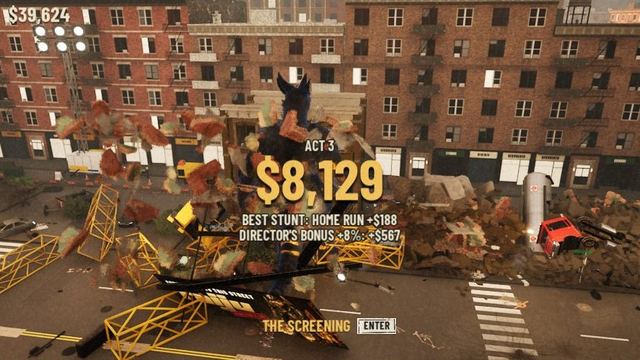
Act 3 CUT: the act's pay, $8,129, counts up over the wrecked street
04

Three acts and the final reel

Three acts: 60, 70 and 80 seconds, about three and a half minutes a run. Each act pays more. Each run ends with THE FINAL REEL: its last 25 seconds pay double.

Your pay rates the film at the box office: Shelved, Straight to Video, Matinee, Hit or Blockbuster.

05

Thunder

Hit things to charge the thunder, then release it as a blast (R). Keep hitting before you let it go, and the blast grows (it overcharges).

When a run ends, press TAKE 2 to go again and beat your best pay.

How to play

Controls

Walk Raiju down the city street set and break everything. The camera follows close behind him while you play. When the clock tower falls, it cuts for about 3 seconds to a wide view of the fall.

ActionKeyboard / mouseGamepad
MoveW A S DLeft stick
Turn the cameraMouseRight stick
Camera: close / farCR3 (right stick click)
SprintLeft ShiftLB
Walk / runLeft CtrlRB
PunchFX
KickGY
Tail whipTRT
Ground slamSpaceA
Shoulder chargeEB
Thunder blast (when the bolt says READY)R or right mouseLT
PauseEscStart
End screen: TAKE 2 / quitEnter / QStart / Back
Screenshots

From the set

In-game captures at 1920 x 1080. Tap or click for the full size.

A punch through a wall in dust and sparks A tanker blows up in the street A lightning bolt by the set crane Raiju over the fallen tower crane The tower comes apart in the final reel Raiju raises both fists in the ruins at the wrap The HUD with pay pops during a thunder hit Raiju on the street set by the ROXBURY cinema
How it was made

One person, a crew of AI agents, four days

Made in four days for the 2026 Epic AI MegaJam, a game-making contest, by one person, Chris, and a crew of Claude AI agents. Chris made the key calls, from the score attack and the robot suit to a front view of Raiju's final bow. The agents wrote the code, ran the builds and made many design calls; two big ones were wrong, and the build log tells how.

To check the work, nine new Claude agents, separate from the jam's real judges and with no memory of the work, scored the game on the jam's seven criteria. Their scores were 18 to 23 out of 35. The last score was for a Sunday-morning version, not the final one.

Other AI tools made the posters, props, intro stills and voices, and Chris made the music with Suno, an AI music tool. Some art and about 12% of the C++ came from his earlier Unreal experiments, also built with AI coding agents.

1,485saved changes (git commits) from Thursday morning to 13:00 Sunday
82,244lines of C++; about 88% written in the jam

Made with Claude Code (Anthropic) and Unreal Engine 5.8, with the jam partners’ tools: OpenAI GPT-5.4 Image 2 (posters), Hyper3D Rodin (props), NVIDIA DLSS 4.5 (upscaling) and Tripo (the suit's base body, two moves); the posters, props and DLSS went in on Sunday. The AI disclosure below says what each made.

Read the build log

Download

Windows 10 or 11

  • Windows 64-bit. If the game won't start, run the Unreal Engine prerequisites installer in the zip first.
  • Windows may warn that the game is from an unknown publisher ("Windows protected your PC"). Click More info, then Run anyway.
  • No Run anyway button? Before you unzip: right-click the zip, choose Properties, tick Unblock, click OK, then unzip.
  • The itch app installs the game without that warning.
  • First start: the intro film (about 60 s; it can be skipped), then the title. Borderless fullscreen at 1920x1080.
  • Known faults: the camera can sit too close behind him, thick dust can hide him for a moment, an outline box can show across his body, and when big buildings fall, the game world can move up to 18% slower than normal.
  • Quality presets: Low, Medium, High, Epic. Gamepad supported. Download: about 2 GB.
AI disclosure

What the AI tools made

  • Who did what: one AI planned the work, others built it, others checked it. Claude Fable 5.2 was the lead agent: it planned the tasks, wrote a brief for each and checked the results. Claude Opus 5.5 agents built and tested each round. Other Opus 5.5 agents worked at the same time on the monster, sound, effects and this site; a few hard pieces on Sunday went to Fable 5.2 workers. The cost of the Claude work was not measured.
  • Code: Claude Code (Anthropic). AI agents wrote all the C++ and Python and drove the Unreal editor by script: the director as a character, the set toys (a tanker, a water tower, a billboard, a tower crane), damage, the menus and the end screen. They also built most of the Niagara effects by script on Epic's template emitters: fire, smoke, dust plumes, sparks, a hydrant jet, storm wind and far lightning; four destruction effects come from a Fab toolkit (see the credits). Separate judge agents, fresh Claude agents with no memory of the work, scored it from stills and video (one also read the code and the logs). Being Claude too, they were not neutral.
  • Animation: Raiju moves on the character setup from Epic's Game Animation Sample (motion matching), carried over from before the jam and declared. The clips it plays for the suit were keyed in the jam by Claude Code agents with scripts in Blender: walk, run, sprint, run-stop, the punches, kick, slam, smash, thunder, roar and the bow. A Fab creature pack (SciFi Beast06) supplies the shoulder charge's run clip and fallback clips. Two combo moves come from Tripo's animation presets. Before the jam, Tripo made the base body that became the robot suit.
  • Art: signs, the set toys, the user interface and the key art were made by Claude Code agents in Blender and Python, with no image model. The buildings are the pre-jam building kit, re-dressed in the jam with CGAxis and Poly Haven surfaces; street props come from City Sample and CGAxis. Concept art (not in the game) came from Grok Imagine Image 2.0 and Qwen Image 3 through the Higgsfield API.
  • The intro film: its painted and ink stills come from Grok Imagine Image 2.0 through the Higgsfield API, from text prompts only. Its moving shots of Raiju are Blender renders of the game's model.
  • Voices: ElevenLabs (model eleven_v3), Voice Library voices: Ed (the director), Xavier (the announcer), Sloane (Val, the agent).
  • Music: tracks made by Chris with Suno: the intro film, the title, the level music and the end screen.
  • Sound: every sound effect and the set ambience were synthesized by code.
  • Posters and props: the in-world film posters (the rooftop billboard and the ROXBURY cinema's boards) were made with OpenAI GPT-5.4 Image 2 (openai/gpt-5.4-image-2, through OpenRouter, text prompts only); 13 film-set props in the crew camps (the director's chair, a film camera, vehicles, trailers, barriers, a lamp, road cases and a camera dolly) with Hyper3D Rodin Gen-2.5 (text prompts only); so were nine street models (shop fronts with striped awnings, fruit and flower stands, cafe tables, a newsstand, a phone booth, a mailbox, a bus shelter and a hot-dog cart), placed as 13 pieces outside the play area. That makes 22 Rodin models in the entry.
  • In short: in the shipped build, AI models made the intro stills (Grok Imagine), the film posters (GPT-5.4 Image 2; two are seen in play), 22 models (Rodin: 13 film-set props, nine street models), the voices (ElevenLabs), the music (Suno, by Chris) and, before the jam, the suit's base body (Tripo); two combo moves come from Tripo's animation presets. Everything else is code and script work by Claude agents (some from before the jam), or the third-party assets in the credits.

Made by Very Bad Games (Chris Sands) for the 2026 Epic AI MegaJam.

Credits

Third-party assets

Epic Games

  • City Sample: road and sidewalk surfaces, road decals and covers, cars and their wrecks, street props and their wrecks, street lamps and trees.
  • Game Animation Sample by Epic Games (Fab): motion matching and character movement.
  • Unreal Engine content: Niagara template emitters and a smoke flipbook.

Fab

  • Quixel Megascans (free): oil stains, a storm drain cover and utility covers on the street.
  • Next Gen Destruction Toolkit by KrisK (Fab, bought): four destruction effects (explosion, breaking concrete, breaking glass, metal impact).
  • SciFi Beast06 Bull by Shumniy (Fab; free giveaway item in the owner's library): a run clip for the shoulder charge and fallback animations.

CGAxis (cgaxis.com)

  • PBR Materials, Brick Walls Materials, Brick Walls Textures, White Plaster 21_88: wall surfaces.
  • Cityscape Downtown and CGAxis Models 113 and 118: street props (lamps, trees, bins, benches, bus stop).
  • Used under Chris's CGAxis plan.

Poly Haven (CC0)

Photo-scanned surfaces for facades, roofs and props: Red Brick, Yellow Brick, Sandstone Blocks 08, White Sandstone Blocks 02 (Rob Tuytel); Whitewashed Brick (Charlotte Baglioni); Concrete Debris, Damaged Plaster (Amal Kumar); Tarred Gravel (Dimitrios Savva); Gravel Floor 02 (Dimitrios Savva, Jenelle van Heerden); Painted Metal Shutter (Charlotte Baglioni, Dario Barresi, Rico Cilliers); Weathered Brown Planks (Dimitrios Savva, Rico Cilliers); Weathered Planks (Dario Barresi, Dimitrios Savva).

NVIDIA

  • NVIDIA DLSS 4.5 (NVIDIA RTX): super resolution, and DLAA at Epic, on GeForce RTX cards. Frame generation was written but left out on purpose: it stays on its own branch, never merged, because its loader is untested on other makers' cards.

Fonts

  • Zero Sky (Envato), the title's lettering, used under Chris's Envato licence.
  • Barlow Condensed, Copyright 2017 The Barlow Project Authors. SIL Open Font License 1.1. (Also used on this site: licence.)
  • JetBrains Mono, Copyright 2020 The JetBrains Mono Project Authors. SIL Open Font License 1.1.
  • Roboto (Google). Apache License 2.0.

Tools: Unreal Engine 5.8, Blender 5.2, Claude Code, Python (numpy, scipy, Pillow), Whisper (local, word checks on voice clips), ffmpeg, Git LFS. The break effects use a method from the free RedefineFX Chaos Crash Course; no course file is in the game.